Last Update on December 29, 2025
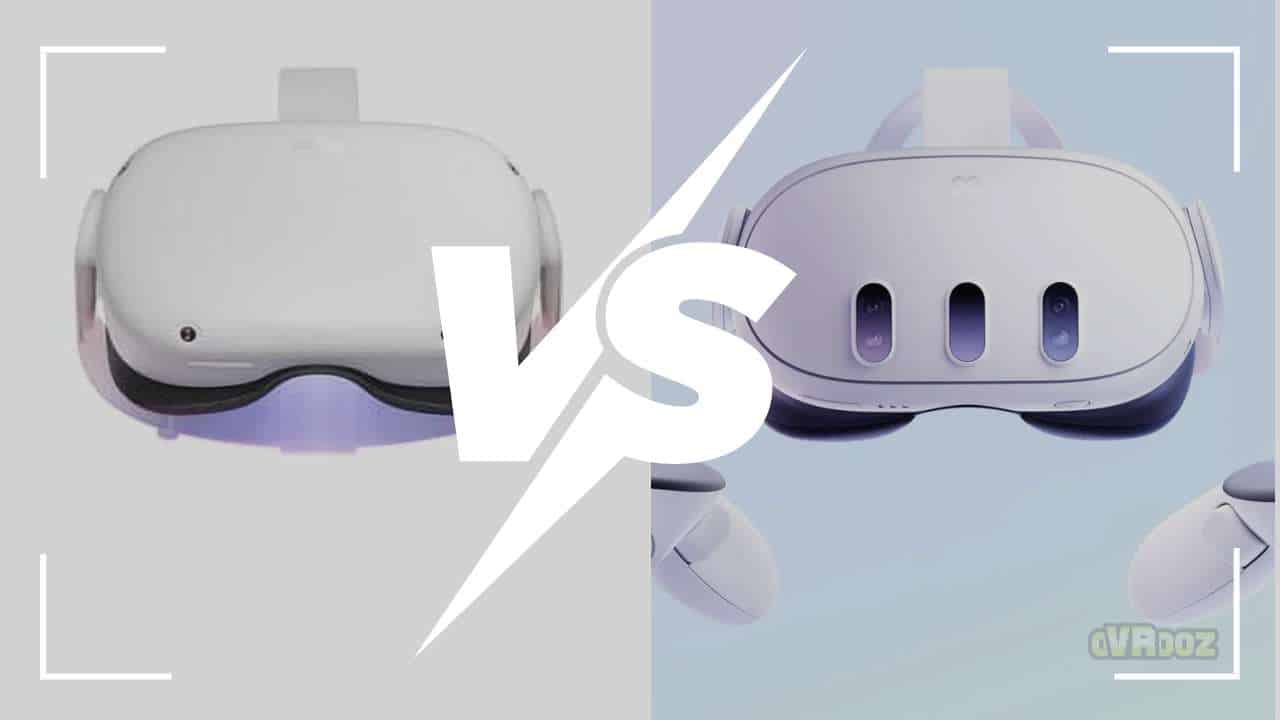
As we enter 2026, the virtual reality market continues its spectacular evolution. Meta, the undisputed leader in the sector, currently offers two headsets that divide consumers: the Meta Quest 2, an accessible veteran that has democratized VR since its launch, and the Meta Quest 3, the latest model offering significant technological advancements. After more than two years of coexisting on the market, which option should you choose in 2026? This comprehensive guide, based on data from late 2025, helps you make an informed decision based on your budget, needs, and expectations for the virtual experience.
Quick Verdict: Which One to Choose in 2026?
For the majority of users in 2026, the Meta Quest 3 represents the wisest investment. With its full-color mixed reality capabilities, its XR2 Gen 2 chip, and revolutionary pancake lenses, it offers a significantly superior experience that justifies the price difference for anyone planning to use VR regularly.
The Quest 2 remains relevant for three specific profiles: tight budgets (under €350), occasional users (less than 5 hours/month), and those who simply want to discover VR without a major financial commitment. However, be aware: Meta has announced that software support for the Quest 2 will gradually end between 2026 and 2027, thus limiting its lifespan.
Our 2026 recommendation: If you are hesitant and your budget allows, invest in the Quest 3. The €200 difference is justified by an incomparable immersive experience, better future resale value, and access to software innovations in the coming years.
Detailed Comparison of Technical Specifications
Specifications are the foundation of the VR experience. Here is an in-depth analysis of the technical differences between these two generations of headsets, updated for 2026 with the latest firmware updates from late 2025.
Full Comparison Table: Meta Quest 2 vs Meta Quest 3 (2026)
| Specification | Meta Quest 2 | Meta Quest 3 | Winner |
|---|---|---|---|
| Official price late 2025 | €249 (128GB) – €299 (256GB) | €549 (128GB) – €699 (512GB) | Quest 2 (accessibility) |
| Display | Fast-Switch LCD, 1832×1920 per eye | Next-gen LCD, 2064×2208 per eye | Quest 3 (+25% resolution) |
| Lenses | Fresnel (concentric rings) | Pancake (40% thinner) | Quest 3 (clarity, weight) |
| Field of View | ~90° horizontal | ~110° horizontal (+20°) | Quest 3 (immersion) |
| Refresh Rate | 72Hz / 90Hz / 120Hz (experimental) | 90Hz / 120Hz (native) | Quest 3 (fluidity) |
| Processor | Snapdragon XR2 Gen 1 (2020) | Snapdragon XR2 Gen 2 (2023) | Quest 3 (2.5× more powerful) |
| RAM | 6 GB LPDDR5 | 8 GB LPDDR5 | Quest 3 (multitasking) |
| Storage | 128GB / 256GB | 128GB / 512GB | Quest 3 (high capacity option) |
| Battery Life | 2-3h (intensive gaming) | 2-2.5h (active mixed reality) | Tie (similar batteries) |
| Weight | 503g | 515g (+12g) | Quest 2 (slightly) |
| Passthrough | Black & white, low resolution | 18 PPD Color, depth sensor | Quest 3 (revolutionary) |
| Audio | Basic integrated speakers | Enhanced spatial audio (+40% volume) | Quest 3 (sound quality) |
| Controller Tracking | 4 infrared cameras | 6 cameras (4 IR + 2 RGB) | Quest 3 (precision) |
| Controllers | Touch V2 (with ring) | Touch Plus (ringless, TruTouch) | Quest 3 (ergonomics) |
| Software Support | Until 2026-2027 (unofficial) | Minimum until 2028-2030 | Quest 3 (longevity) |
Crucial point for 2026: Meta has begun optimizing certain games exclusively for the Quest 3, notably thanks to the XR2 Gen 2 chip. Titles like Assassin’s Creed Nexus VR and Asgard’s Wrath 2 run significantly better on Quest 3, with enriched graphics and superior draw distances.
Design and Comfort: The Evolution Over Two Years of Use
Comfort remains a determining factor for prolonged VR sessions. After two years of user feedback, here is what really differentiates these headsets in daily use.
Ergonomics and Weight Distribution
The Quest 2 suffers from an initial design flaw: its basic elastic strap creates uncomfortable frontal pressure after 45 minutes of use. The community has massively adopted third-party straps (BoboVR M2 Pro, Kiwi Design Elite) to improve comfort. With the original strap, the Quest 2 feels heavy on the cheekbones and forehead.
The Quest 3 benefits from better weight distribution thanks to its more compact profile (40% depth reduction thanks to pancake lenses). Despite its extra 12 grams, it wears better than the Quest 2. The provided strap remains basic, and investing in a premium strap (Elite Strap, BoboVR M3) considerably improves the experience for sessions longer than an hour.
Adjustment and Settings
Both headsets use an IPD (interpupillary distance) adjustment system: the Quest 2 offers 3 fixed positions (58mm, 63mm, 68mm), while the Quest 3 offers continuous adjustment between 53mm and 71mm via a wheel, adapting to more face shapes.
The Quest 3’s ventilation has been improved, reducing fogging during intense physical activities (Beat Saber, Thrill of the Fight). The Quest 2 often requires a third-party fan for users sensitive to this issue.
Display and Lenses: The End of the Fresnel Era
This is probably THE most noticeable difference between these two headsets: the display and lens technology.
Resolution and Image Clarity
The Quest 3 displays 2064×2208 pixels per eye compared to 1832×1920 for the Quest 2, representing a 30% increase in pixel density. This difference translates to:
- Significantly more readable text in virtual environments (crucial for VR work)
- Visible reduction of the “screen-door effect”
- Better definition of distant objects in open-world games
- Overall immersion improvement thanks to finer details
Pancake vs. Fresnel Lenses: A Revolution
The transition from Fresnel lenses (Quest 2) to pancake lenses (Quest 3) constitutes the most significant evolution of this generation:
Fresnel Lenses (Quest 2):
- Visible concentric rings creating light aberrations (god rays)
- Limited sharpness zone in the center (reduced sweet spot)
- Require precise adjustment for an optimal image
- Advantage: lower production cost
Pancake Lenses (Quest 3):
- Uniform clarity across the entire field of vision
- Near-total elimination of god rays and chromatic aberrations
- Headset depth reduced by 40%, improving balance
- Considerably widened sharpness zone (sweet spot)
- Disadvantage: slight loss of brightness (compensated by software)
For glasses wearers, the Quest 3 offers more space thanks to its redesigned profile, although the provided spacer works on both models.
Mixed Reality and Passthrough: The Technological Gap

If only one element had to justify the price difference between these headsets in 2026, it would be mixed reality.
Quest 2: Utility Passthrough
The Quest 2’s passthrough is akin to a low-end webcam from the 2000s:
- Black and white display only
- Low resolution (about 4 PPD – pixels per degree)
- Perceptible latency (about 50ms)
- Only usable for repositioning a guardian or finding your controllers
- No viable mixed reality applications
Quest 3: Functional Mixed Reality
The Quest 3 transforms passthrough into a daily usable feature:
- Faithful full color with automatic white balance
- 18 PPD resolution (4.5× higher than Quest 2)
- Integrated depth sensor allowing realistic occlusion
- Latency reduced to about 12ms (imperceptible)
- Viable productivity applications (web browsing, multitasking)
- Immersive mixed reality games (First Encounters, Demeo, Piano Vision)
In 2026, the mixed reality application ecosystem has considerably expanded on Quest 3. Apps like Spatial Touch, Painting VR in mixed mode, and multi-screen virtual desktop functions fully exploit these capabilities. The Quest 2 is totally excluded from this ecosystem.
Practical impact: The Quest 3 can stay on your head in passthrough mode while you check your phone, drink a coffee, or interact with your physical environment. The Quest 2 must be removed for these same actions.
Gaming Performance and 2026 Exclusives
Does raw power translate into a better gaming experience? Analysis of real performance in 2026.
Processing Power: XR2 Gen 1 vs. Gen 2
The Quest 3’s Snapdragon XR2 Gen 2 offers:
- 2.5× more powerful GPU: stable frame rates at 120Hz even in demanding games
- 40% faster CPU: reduced loading times, better physics management
- 8 GB of RAM: allows for high-resolution textures and less pop-in
- Energy efficiency: despite higher power, consumption is comparable to Quest 2
Comparison on Popular Games (Late 2025 Tests)
Beat Saber: Equivalent performance on both headsets (the game is not graphically demanding). Quest 3 advantage for the clarity of distant notes thanks to better resolution.
Resident Evil 4 VR: The Quest 3 displays “Enhanced” graphics with superior draw distances, dynamic shadows, and improved lighting effects. Runs at a stable 90fps vs. 72fps on Quest 2.
Asgard’s Wrath 2: Designed for the Quest 3, the game works on Quest 2 but with considerably reduced graphics (low-res textures, limited draw distances, disabled effects).
Contractors Showdown / Population: One: The Quest 3 maintains a constant 90fps even in multiplayer, where the Quest 2 shows drops to 72fps during intense action.
Quest 3 Exclusive Games and Features (2026)

Meta has confirmed that some games releasing in 2026 will be Quest 3 exclusives:
- Batman: Arkham Shadow (AAA action-adventure)
- Behemoth (from the studio behind The Walking Dead: Saints & Sinners)
- All future advanced mixed reality experiences
- Exclusive graphical updates for Metro Awakening, Assassin’s Creed Nexus
PCVR: Steam Link and Air Link
For wireless PCVR streaming:
- The Quest 3 decodes video more efficiently (AV1 codec supported)
- The Quest 3’s higher resolution better exploits high-definition PC graphics
- Comparable latency on both headsets with a dedicated Wi-Fi 6 router
- The Quest 2 remains capable for PCVR if you already own a gaming PC
Gaming verdict: If you primarily play intensive native Quest games or plan to keep your headset for several years, the Quest 3 is a must. For exclusively PCVR games, the Quest 2 remains competent.
Price and Value for Money: 2026 Analysis
Official Pricing and Promotions
Meta Quest 2 (late 2025):
- 128 GB: €249 (reduced price following the Quest 3’s arrival)
- 256 GB: €299 (often on sale for €269)
- Used market: €150-200 in good condition
Meta Quest 3 (late 2025):
- 128 GB: €549 (pack often including a free game)
- 512 GB: €699 (recommended for power users)
- Used market: €400-450 (rarely available, recent product)
Total Cost of Ownership (TCO)
Beyond the purchase price, consider:
Recommended accessories (identical for both):
- Third-party comfort strap: €40-90 (BoboVR M2 Pro, Kiwi Design Elite)
- Silicone face interface: €15-25
- External battery / power bank: €50-100 (for long sessions)
- Carrying case: €25-40
- Total accessories: €130-255
Resale value (2027 estimate):
- Quest 2: €100-150 (fast depreciation, end of support near)
- Quest 3: €350-400 (holds value, long-term support)
Value for Money: The Honest Calculation
Investment over 3 years (2026-2029):
Quest 2 (256GB):
- Purchase: €299
- Accessories: €150
- 2029 Resale: -€100
- Net cost: €349 or €9.7/month
- Limits: Limited software support after 2027, no mixed reality
Quest 3 (128GB):
- Purchase: €549
- Accessories: €150
- 2029 Resale: -€350
- Net cost: €349 or €9.7/month
- Advantages: Support until 2030, mixed reality, superior performance
Surprising conclusion: Over 3 years, the monthly cost is identical thanks to the Quest 3’s better resale value. You benefit from a significantly superior experience for the same spread-out budget.
Lifespan and Software Support: A Critical Factor
In 2026, the question of software support becomes central in choosing between these headsets.
Quest 2 Life Cycle
Launched in October 2020, the Quest 2 will reach 6 years in 2026. Meta has unofficially confirmed:
- Security updates guaranteed until late 2026
- Support for new features slowed down since late 2024
- Major new games increasingly rare (Quest 3 focus)
- Commercial end-of-life likely during 2026
For a purchase in 2026, you benefit from a maximum of 1 year of optimal active support.
Future of the Quest 3
The Quest 3, released in October 2023, will benefit from:
- Active software support at least until 2028 (5-year standard)
- Probably until 2030 given the technological investment
- Priority platform for new developments
- Compatible with the Horizon OS ecosystem announced for 2026
A purchase in 2026 guarantees a minimum of 4-5 years of use with full support.
Impact on Games and Applications
Since late 2024, developers have been prioritizing optimization for Quest 3:
- “Quest 3 Enhanced” graphics becoming the norm
- Mixed reality features totally ignoring the Quest 2
- Some studios are dropping Quest 2 compatibility for 2026 releases
In 2027-2028, the Quest 2 will likely be in the same situation as the Oculus Quest 1 today: functional but excluded from new releases.
Controls, Tracking, and User Experience
Controllers: Touch vs. Touch Plus
Touch V2 (Quest 2):
- Proven design with tracking ring above the hand
- Excellent battery life (30-40h with AA batteries)
- Comfortable ergonomics but bulky during close movements
- Basic haptic feedback
Touch Plus (Quest 3):
- Ringless design, tracking integrated into the controller body
- More compact, allowing natural movements (hands near face)
- TruTouch technology: improved haptics (more precise vibrations)
- Identical battery life (standard AA batteries)
- Pressure detection on triggers for nuanced interactions
Tracking Quality
The Quest 3 integrates 6 cameras (vs. 4 on Quest 2):
- Expanded tracking zone, notably behind the head
- Faster recovery after controller occlusion
- Improved hand tracking (hand tracking without controllers)
- Fewer “dead zones” during extreme movements
In daily practice, the difference remains minor for most games but perceptible in fitness experiences (FitXR, Supernatural) and competitive shooters.
Use Cases and Personalized Recommendations
Choose the Meta Quest 2 if:
- Strict budget: Less than €350 available for the headset + accessories
- Occasional use: Less than 5h of VR per month, mainly for family demos
- VR discovery: First VR experience, uncertainty about long-term use
- PCVR focus: 80%+ use streaming from a powerful gaming PC
- Simple games: Limited interest in lightweight games (Beat Saber, Mini Golf, Walkabout)
- Children: Purchase for a child aged 10-13 (lower investment in case of breakage)
Choose the Meta Quest 3 if:
- Regular use: More than 10h of VR per month planned
- AAA games: Interest in high-end productions (Assassin’s Creed, Batman, Behemoth)
- Mixed reality: Curiosity for mixed applications, VR productivity
- Visual comfort: Sensitivity to aberrations, god rays, screen-door effect
- Long-term investment: Desire to keep the headset for 3-5 years
- Tech enthusiast: Desire to have the best current VR equipment
- VR fitness: Intensive use for sports (better ventilation, tracking)
Special Cases
Quest 2 owners hesitant to upgrade: The upgrade is worth it if:
- You use your Quest 2 more than 15h/month
- God rays and black/white passthrough frustrate you
- You want access to upcoming Quest 3 exclusive games in 2026
- You can resell your Quest 2 for €150+
Keep your Quest 2 if your use remains occasional and you are satisfied with current games.
Alternatives to Consider in 2026
Before finalizing your choice, consider these alternatives:
Pico 4: The Direct Competitor
The VR Pico 4 positions itself between Quest 2 and Quest 3:
- Price: €379 (more accessible than Quest 3)
- Pancake lenses (like Quest 3)
- Resolution comparable to Quest 3
- Better weight balance (battery at the back)
- Limit: smaller game library, less mature ecosystem
Interesting option for exclusive PCVR, less relevant for standalone games.
PlayStation VR2: For Console Gamers
If you own a PS5:
- Price: €599 (requires a PS5)
- Superior graphics thanks to console power
- PlayStation exclusives (Horizon Call of the Mountain, Resident Evil Village)
- Limit: wired, no standalone games
Quest 3S: The Available Compromise
Meta launched the “Quest 3S” in late 2025, positioning an interesting compromise:
- Price: €399-449
- Quest 3 Processor (XR2 Gen 2)
- Quest 2 Fresnel lenses (reduced cost)
- Intermediate resolution
- Improved color passthrough compared to Quest 2
This model represents an excellent quality-price sweet spot for medium budgets in 2026.
FAQ: Frequently Asked Questions about Quest 2 vs Quest 3
Is the Meta Quest 2 still supported in 2026?
Yes, the Quest 2 is still receiving security updates in early 2026. However, Meta has slowed the deployment of new features, favoring the Quest 3. Active support is expected to continue until late 2026, with minimal security support until 2027. New AAA games releasing in 2026 will be increasingly optimized exclusively for Quest 3, or even incompatible with Quest 2.
Do Quest 3 games work on Quest 2?
Most games remain compatible with both headsets, but with significant graphical differences. Games marked “Quest 3 Enhanced” run on Quest 2 with reduced graphics (low-res textures, limited draw distances, disabled effects). Some games releasing in 2026 and beyond are announced as Quest 3 exclusives, especially those intensively exploiting mixed reality or requiring the power of the XR2 Gen 2. Always check compatibility on the store before purchasing.
Is the price difference worth it for occasional use?
For strictly occasional use (less than 5h/month, mainly Beat Saber and mini-games), the Quest 2 remains sufficient and represents better immediate value for money. The €250-300 difference is hard to justify if you don’t exploit the advanced capabilities. However, if your “occasional use” is likely to evolve into regular use, or if you plan to keep the headset for 3-4 years, the Quest 3 becomes relevant thanks to its better durability, extended software support, and superior resale value.
Can Quest 2 accessories be used on the Quest 3?
Partially. Third-party straps compatible with Quest 2 generally fit the Quest 3 (same attachment points), but the slightly different shape may affect comfort. Silicone face interfaces are NOT compatible (different dimensions). Carrying cases fit depending on the model. External batteries and power banks work on both (USB-C). Lens protectors must be specific to the Quest 3 (different diameter). Always check compatibility with the manufacturer before purchasing.
Which storage capacity should I choose?
For the Quest 2: The 128 GB version is enough for most users (15-25 games depending on size). Choose 256 GB only if you install more than 30 games simultaneously or download many 360° videos. For the Quest 3: 128 GB is suitable for moderate players. The 512 GB version is recommended for power users, game collectors, or those who record a lot of high-resolution gameplay. Since Quest 3 games are heavier (improved graphics), capacity fills up faster.
Is the Quest 3 really twice as good as the Quest 2?
It is not “twice as good” in a linear way, but it offers major qualitative improvements in several key areas: visual clarity (+30% resolution, pancake lenses eliminating aberrations), mixed reality (transformation from unusable to fully functional), performance (2.5× GPU allowing superior graphics), and longevity (3-4 more years of software support). For some user profiles (occasional, limited budget, exclusive PCVR), this improvement does not justify double the price. For VR enthusiasts, the experience gap widely justifies the investment.
Conclusion: The Final Verdict for 2026
After an in-depth analysis of specifications, user feedback, and VR market trends in late 2025, here is our definitive recommendation for 2026:
The Meta Quest 3 represents the recommended purchase for 90% of users in 2026. Its advancements in mixed reality, visual clarity thanks to pancake lenses, superior processing power, and extended software support (until 2028-2030) justify the additional €250 investment. Calculated over 3-4 years of use with resale value, the monthly cost becomes comparable to the Quest 2 while offering an incomparably superior experience.
The Quest 3 is not simply an “update” to the Quest 2, but a generational evolution bringing fundamentally new capabilities, especially in mixed reality. The ecosystem of apps and games in 2026 now requires these capabilities, and this trend will intensify through 2027-2028.
The Meta Quest 2 remains relevant only for three profiles: strict budgets (less than €300 available), exclusive PCVR streaming users (where it still performs correctly), and those wanting to “test” VR without a major financial commitment before a potential upgrade. In these cases, the Quest 2 offers an accessible entry point to quality VR experiences, but with a limited lifespan (active support ending late 2026).
If you are still hesitant, ask yourself this question: “How long will it take before I regret not getting the Quest 3?” For the majority of buyers, the answer is “6 months to 1 year,” as soon as the Quest 2’s limitations (unusable passthrough, reduced graphics, exclusion from new games) become frustrating. Investing €250 more today avoids buying a new headset in 18 months.
Our final advice for 2026: If your budget allows (€549 + €100-150 in accessories), opt for the Quest 3 in the 128 GB version. If the budget is truly constrained, consider the Quest 3S launched in late 2025 (€399-449) which offers an excellent compromise. If the budget is strictly limited, wait for promotions on the Quest 3 (frequent during Black Friday, sales) rather than buying a new Quest 2 at full price. The used market also offers Quest 2s for €150-180, an interesting option to discover VR before a future upgrade.
Virtual reality is evolving rapidly, and in 2026, investing in the Quest 3 positions you on the right side of this evolution for years to come.