Last Update on December 29, 2025
The Playroom VR represents a fundamental milestone in the history of PlayStation virtual reality. Launched at the dawn of the PSVR era, this free title proved that VR could be accessible, social, and fun for everyone. In 2026, as PSVR 2 technology dominates the market and VR games compete in realism, The Playroom VR maintains a unique place in players’ hearts thanks to its innovative asymmetric multiplayer approach and its collection of varied mini-games. This comprehensive analysis examines how this classic performs in 2026, how to play it on PS5, and why it remains a must-have for any PlayStation VR headset owner.
The Playroom VR in 2026: Still the King of Free Party Games?
In 2026, the virtual reality landscape has evolved considerably. Modern VR headsets offer 4K resolutions, eye tracking, and advanced haptic technologies. Yet, The Playroom VR retains a remarkable relevance that defies the passage of time. Its total lack of cost makes it an ideal entry point for newcomers to VR, while its asymmetric gameplay concept remains unique in the PlayStation ecosystem.
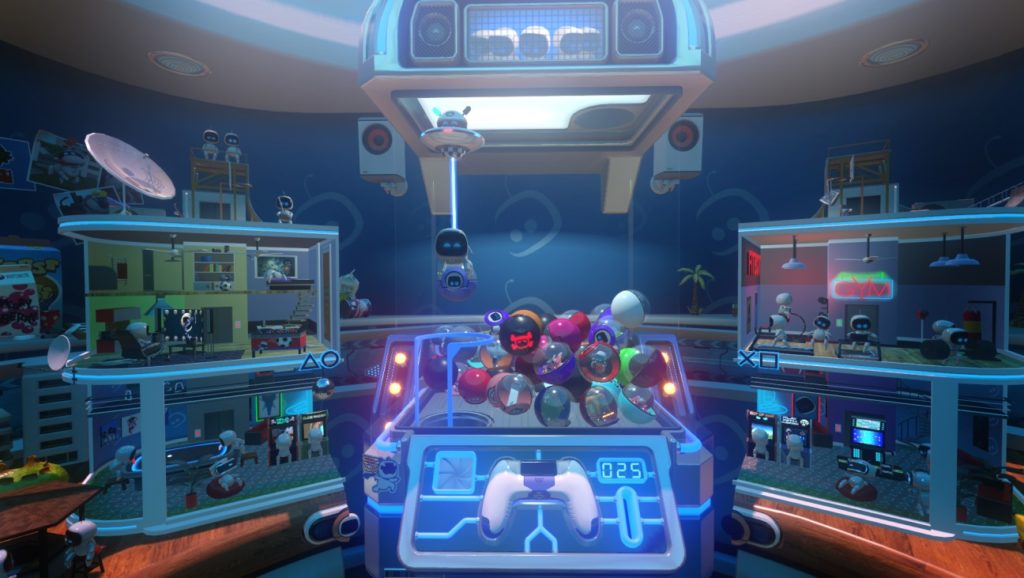
The legacy of The Playroom VR is particularly evident through the phenomenal success of Astro Bot, whose iconic character made its debut in the Robot Rescue mini-game of this compilation. This little robot has become, in 2025-2026, the true mascot of PlayStation, with AAA titles that have conquered both critics and the public. This lineage creates a powerful nostalgia that regularly brings players back to The Playroom VR.

Compared to recent VR party games like Rec Room or VRChat, The Playroom VR stands out for its simplicity of access and its local approach. Where most modern VR games prioritize online multiplayer, The Playroom VR shines in parties with friends and family, creating authentic social interactions in the same physical space. This local social dimension, combined with instantly understandable mini-games, makes it a perfect tool for introducing neophytes to VR without intimidating them.
The game has also benefited from a passive improvement thanks to the PS4 Pro and PS5 backward compatibility. On these more powerful machines, the framerate remains locked at 120 fps for the VR headset, guaranteeing impeccable fluidity that minimizes the risk of motion sickness. This technical stability largely compensates for the modest resolution of the original PSVR, proving that optimization takes precedence over raw power in virtual reality.
Mini-games Under the Microscope: From Monster Escape to Robot Rescue
The Playroom VR offers six distinct mini-games, each exploiting the headset’s capabilities and the asymmetric interaction between the VR player and TV players differently. This variety is the title’s main strength, offering experiences for all tastes and skill levels.
Robot Rescue remains the jewel of the collection. This 3D platformer mini-game plunges the VR player into a colorful universe where they must guide a small robot through levels filled with obstacles. The use of VR depth is masterful: leaning your head allows you to discover secret passages, creating a sense of wonder that foreshadows the excellence of Astro Bot Rescue Mission. In 2026, this mini-game remains a perfect demonstration of VR’s narrative and ludic potential for platformers.
Monster Escape brilliantly illustrates the asymmetric concept. One player in VR plays a giant monster destroying a city, while up to four players on TV control vehicles trying to escape. The palpable tension between hunter and prey generates guaranteed laughter, especially when the VR monster frantically scans the screen to locate its victims. This asymmetry creates a unique social dynamic, rarely matched in later VR games.
Cat and Mouse reverses the roles: the VR player becomes a giant cat, while TV players play mice collecting cheese. Interaction relies on coordination and communication, with the cat having to anticipate the mice’s movements while managing its limited field of vision. This mini-game excels in family evenings, its accessibility allowing even the youngest to participate.
Wanted! transforms the living room into a western scene. TV players try to identify bandits in the crowd, while the VR player must eliminate them with precision. This mini-game values reactivity and teamwork, creating moments of comic tension when communication gets muddled.
Ghost House offers a ghost hunt where the VR player explores a haunted house while TV players spot specters on the map. The slightly spooky atmosphere without being traumatic is perfect for family sessions, proving that VR can generate varied emotions.
Toy Wars closes the selection with a multiplayer shooting game where the VR player faces TV players in an arena. Less innovative than the other modes, it nonetheless remains pleasant for quick and competitive confrontations.
Graphics and Immersion: Rendering on PS4 Pro and PS5
In 2026, VR visual standards have progressed considerably. Headsets like the Meta Quest 3 or PSVR 2 display photorealistic textures and environments of impressive density. Faced with this evolution, The Playroom VR fully embraces its stylized and colorful aesthetic, which ages much better than the graphic realism of some contemporary titles.
The artistic direction prioritizes clarity and readability, with clean but charming environments. The Astro robots feature an effective minimalist design, while the settings use bright colors that facilitate spatial orientation in VR. This approach remains perfectly functional in 2026, proving that artistic coherence takes precedence over the polygon race.
On PS4 Pro and PS5, the game benefits from slightly improved textures and supersampling that reduces aliasing, that jagged edge defect particularly visible in early VR games. The perfectly stable framerate ensures a comfortable experience, even for players sensitive to motion sickness. This technical optimization, combined with the precise tracking of the PlayStation Camera and DualShock 4 controllers, offers a fluid immersion that surpasses some technically more ambitious but less well-optimized titles.
3D spatial audio contributes significantly to immersion. Sounds come from precise directions, allowing the VR player to instinctively locate important elements. In Robot Rescue, hearing an enemy approach from behind creates palpable tension, while in Monster Escape, the panicked cries of TV players resonate hilariously in the headset.
How to Play The Playroom VR on PS5 in 2026?
One of the most frequent questions in 2026 concerns the compatibility of The Playroom VR with modern configurations. The answer requires some important technical clarifications for players wishing to rediscover this classic.
Required Hardware:
- PS4, PS4 Pro, or PS5 console
- PlayStation VR headset (Generation 1) – not compatible with PSVR 2
- PlayStation Camera (original PS4 camera)
- DualShock 4 Controller (PS4 controller)
- PlayStation Camera Adapter for PS5 (free via Sony request until late 2025, available for purchase since 2026)
PS5 Configuration: Playing The Playroom VR on PS5 is possible through PSVR 1 backward compatibility but requires several steps. The camera adapter is essential because the PS5 does not natively include a port for the PS4 camera. This adapter, distributed for free by Sony to PSVR owners during the transition period, must now be purchased separately for about $15-20.
Once the adapter is connected, the console automatically detects the PSVR. Crucial point: you must use a DualShock 4 controller, as the PS5 DualSense is not compatible with backward-compatible PSVR games. Connect the DualShock 4 via USB cable to sync it with the PS5, then launch The Playroom VR from your game library.
Absence of PSVR 2 Version: Unfortunately, Sony has not announced a port of The Playroom VR for PSVR 2. This decision disappoints many players wishing to rediscover these mini-games with advanced Sense controllers and the higher resolution of the new headset. According to industry sources, this absence is due to Sony’s desire to concentrate its resources on new titles rather than remasters of free games. Fans nonetheless hope for a surprise in future system updates.
Download and Installation: The Playroom VR remains available for free on the PlayStation Store in 2026. The download is approximately 3.5 GB, a modest size by current standards. No PlayStation Plus subscription is required, confirming Sony’s commitment to keeping this title accessible to all PSVR owners.
Sound and Audio Atmosphere: 3D Audio Serving Immersion
The sound design of The Playroom VR perfectly illustrates the importance of audio in VR immersion. Each mini-game benefits from a distinct sound atmosphere that reinforces the identity of the experience while providing crucial audio cues for gameplay.
3D spatial audio, processed by the PSVR’s external processor, creates a convincing soundstage. In Robot Rescue, the mechanical noises of enemies, the clinking collectibles, and the adorable voices of the little robots come from precise directions in virtual space. This spatialization helps the player locate elements without even seeing them, transforming audio into a gameplay mechanic in its own right.
The musical compositions remain light and cheerful, avoiding saturating the experience. Each musical theme corresponds to the mini-game’s atmosphere: upbeat for Toy Wars, mysterious for Ghost House, frantic for Monster Escape. This variety prevents auditory fatigue during prolonged sessions, a common pitfall in multi-activity games.
The quality of the audio mixing remains remarkable in 2026. Sound effects remain distinct even during the most chaotic moments, allowing the VR player to process multiple sources of information simultaneously. This audio clarity partially compensates for the original PSVR’s graphic limits, proving that careful sound design contributes as much to immersion as sophisticated visual rendering.
Multiplayer Modes and Social Experience
The true innovation of The Playroom VR lies in its approach to local asymmetric multiplayer. In 2026, while most popular VR games prioritize online multiplayer, this title reminds us of the irreplaceable value of physical social interactions.
The Social Screen concept, where the TV screen displays a different viewpoint from the VR headset, transforms passive spectators into active participants. This mechanic eliminates the isolation often associated with VR, creating a shared experience where laughter and exclamations flow naturally in the room. Parents particularly appreciate this inclusive dimension, allowing the whole family to play together despite having only one headset.
The asymmetric balance varies intelligently across mini-games. In Monster Escape, the VR player has immense power but a limited field of vision, compensated by the mobility and number of TV players. In Cat and Mouse, balance relies on communication: the VR cat must announce its intentions to coordinate with its team. These dynamics create unpredictable situations where skill matters less than collective strategy.
Compared to multiplayer experiences on Steam VR or Meta Quest games, The Playroom VR offers refreshing simplicity. No complex network configuration, no accounts to create, no latency to manage: plug in the headset and play. This instant accessibility makes it a preferred choice for VR demonstrations at family events or among neophyte friends.
Summary Table: Pros and Cons in 2026
| Pros | Cons |
|---|---|
| ✅ Totally free on PlayStation Store | ❌ Resolution limited by PSVR 1 hardware |
| ✅ Innovative and social asymmetric multiplayer | ❌ No PSVR 2 compatibility announced |
| ✅ Six varied and accessible mini-games | ❌ Limited lifespan (2-3h to experience everything) |
| ✅ Perfect for introducing beginners to VR | ❌ Requires DualShock 4 on PS5 (incompatible DualSense) |
| ✅ Origin of the Astro Bot phenomenon | ❌ Camera adapter required for PS5 (paid in 2026) |
| ✅ Optimal performance on PS4 Pro/PS5 | ❌ Limited content compared to modern VR games |
| ✅ Timeless artistic design | ❌ Absence of online modes |
The Astro Bot Legacy: From Robot Rescue to Global Phenomenon
It would be impossible to analyze The Playroom VR in 2026 without mentioning the incredible success of Astro Bot, which became one of PlayStation’s flagship franchises in 2025. The little robot that frolicked in Robot Rescue has conquered the video game world, proving that ideas sometimes germinate in the most modest projects.
Astro Bot Rescue Mission (2018) transformed the mini-game concept into a full adventure, garnering rave reviews and setting new standards for VR platformers. Its non-VR successor on PS5, Astro’s Playroom, became the console’s technical showcase in 2020. Finally, Astro Bot (2025) consolidated the character’s mascot status, rivaling Mario and Sonic in terms of recognition and ludic excellence according to critical analyses.
This lineage creates renewed interest in The Playroom VR. Astro Bot fans curious to discover the character’s origins download the game to experience Robot Rescue, creating a virtuous circle that keeps the title relevant nine years after its launch. This exceptional longevity is a testament to the fundamental quality of Japan Studio’s design (now Team Asobi).
Comparison with VR Alternatives in 2026
The VR party game market has developed considerably since 2016. Titles like Beat Saber, Walkabout Mini Golf VR, or Gorilla Tag offer accessible and fun multiplayer experiences. However, The Playroom VR retains distinctive advantages.
Unlike online games, The Playroom VR requires no internet connection, eliminating latency issues and community toxicity. Its local multiplayer promotes authentic interactions, creating shared memories in physical space rather than forgotten pseudonyms in virtual lobbies.
Faced with free Meta Quest games, The Playroom VR stands out for its variety. Where many VR free-to-play titles focus on a single concept, this title offers six distinct experiences, increasing its replay value for short and varied sessions.
Compared to new PSVR 2 party games like some titles in the modern library, The Playroom VR remains competitive thanks to its accessibility. PSVR 2 games certainly exploit advanced technologies (eye-tracking, Sense controller haptic feedback), but their learning curve can intimidate novices. The Playroom VR prioritizes immediacy: two minutes of explanation are enough for grandma to face the grandkids in Cat and Mouse.
Tips and Tricks to Optimize the Experience
Optimal Setup: To maximize VR comfort, meticulously adjust the headset before starting. The headband should rest firmly without excessive tightening, with the lenses aligned with your pupils. Take the time to perform the interpupillary distance adjustment in the PS4/PS5 settings for optimal sharpness.
Room Lighting: The PlayStation Camera requires stable but not excessive lighting. Avoid direct light sources behind the player (windows, lamps) that create backlighting. Uniform ambient lighting ensures precise tracking, reducing frustrating sync losses.
Play Space: Although The Playroom VR is primarily played seated, leave about 2 meters between the player and the camera. This distance allows for optimal head movement tracking while keeping the player in the camera’s field of vision.
Mini-game Rotation: To maintain interest during group sessions, rotate roles regularly. Let each participant try the VR headset in different mini-games rather than monopolizing one mode. This rotation ensures that no one gets bored and everyone experiences the magic of VR.
Motion Sickness Management: The Playroom VR is among the least nausea-inducing VR games thanks to its stable framerate and limited movement. Nevertheless, if a player feels discomfort, remove the headset immediately and take a break. Consult our complete guide on VR motion sickness for progressive acclimation techniques.
Recording Memorable Moments: The PS4/PS5 allows you to easily capture gameplay sessions. Use the Share/Create button to immortalize the hilarious reactions of VR players discovering Monster Escape or heroic victories in Robot Rescue. These videos become precious memories of your VR evenings.
Verdict 2026: An Essential Free Classic
In 2026, The Playroom VR transcends its status as a simple game to become a cultural phenomenon in PlayStation virtual reality history. Its free nature, accessibility, and asymmetric multiplayer approach make it a unique title that has never truly been surpassed in its category.
The technical limits of the original PSVR are certainly felt compared to modern headsets, but the excellence of the game design largely compensates for these constraints. The mini-games remain relevant, fun, and perfectly balanced, offering instantly rewarding experiences that respect players’ time.
The absence of a PSVR 2 version remains disappointing, depriving modern headset owners of an improved experience with Sense controllers and higher resolution. This technical limitation is the main obstacle to a universal recommendation of the game in 2026, restricting its audience to owners of the first-generation PSVR ecosystem.
For owners of PS4, PS4 Pro, or PS5 equipped with the original PSVR, The Playroom VR remains an absolutely mandatory download. Its lack of financial cost, combined with its ludic and social richness, makes it one of the best value-for-money titles in video game history. Whether you want to introduce friends to VR, organize a memorable family evening, or simply relive the beginnings of the Astro Bot adventure, this title amply deserves its place in your library.
Final Score: 8.5/10 – A timeless classic whose accessibility and social fun compensate for technical limitations. Essential for any PSVR 1 owner.
Frequently Asked Questions (FAQ)
Can you play The Playroom VR on PS5?
Yes, through PSVR 1 backward compatibility. You will need the original PSVR headset, the PS4 PlayStation Camera, a DualShock 4 controller, and the camera adapter for PS5. The game works perfectly with improved performance on the next-gen console.
Is The Playroom VR compatible with PSVR 2?
No, unfortunately The Playroom VR is not compatible with PSVR 2 in 2026. Sony has not announced any port or update for the new headset. The game remains exclusively playable with the first-generation PSVR on PS4, PS4 Pro, and PS5 via backward compatibility.
Do you need PS Move controllers to play The Playroom VR?
No, The Playroom VR is played exclusively with the DualShock 4 controller. PlayStation Move controllers are not supported by this title. On PS5, you must use a DualShock 4 because the DualSense is not compatible with backward-compatible PSVR games.
How many players can participate simultaneously?
Up to five players: one in VR with the headset, and four others on the television with additional DualShock 4 controllers. The exact number of participants varies depending on the chosen mini-game, with some supporting fewer simultaneous players.
Does the game require a PlayStation Plus subscription?
No, The Playroom VR is completely free and requires no subscription. Simply download it from the PlayStation Store and play at no additional cost. Since multiplayer is local, no internet connection is necessary after installation.